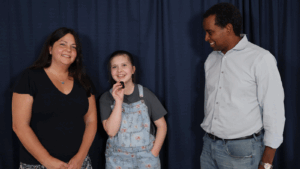
Melissa and Ally Tumblin talk about Ally’s Act with Congressman Joe Neguse, September 10th, 2025.
FOR IMMEDIATE RELEASE:
Wednesday, September 10, 2025
Contact: Grace Martinez
VIDEO: Rep. Neguse Joins Ally and Melissa Tumblin to Introduce “Ally’s Act,” Legislation to Expand Coverage for Specialized Hearing Devices
Washington, D.C. — Colorado Congressman Joe Neguse has once again teamed up with Rep. Brian Fitzpatrick (R-PA) to introduce “Ally’s Act,” a bipartisan bill that would ensure private insurance companies cover osseointegrated hearing devices (“OIDs”), including bone anchored hearing aids (“BAHA”) and cochlear implants. The legislation is inspired by Ally Tumblin, a 16-year-old Colorado native, who was born without a right ear or hearing canal—conditions known as microtia and aural atresia—and requires the use of a BAHA.
After Ally’s insurance company denied coverage of her hearing device, her mother, Melissa Tumblin, formed the organization Ear Community in 2016 to advocate for insurance coverage of these devices to ensure no person is left unable to hear because of private insurance companies’ refusal to provide coverage. Then, in 2019, during Congressman Neguse’s first term in the U.S. House, he received a letter from Ally detailing her circumstances. After learning about her situation and the similar circumstances of Americans living with microtia and aural atresia, Neguse first introduced Ally’s Act.
“The bill is really simple. It is an effort to help Coloradans and Americans ensure that they have access through their health insurance plans to bone anchored hearing devices, which, right now, are not available on the vast majority of health insurance plans under the Affordable Care Act. We’ve got to change it. And really, this bill only came about because of Melissa and Ally Tumblin. It was their story—and Ally’s story—that really helped us conceive of Ally’s Act, and I couldn’t be more grateful to both of them for their courage and their willingness to be a part of the solution,” said Congressman Neguse in a video highlighting the bill.
Watch the full video HERE.
“Bone anchored hearing systems and cochlear implants are the only hearing devices some children and adults can benefit from. When an insurance provider denies coverage for someone in need of one of these hearing devices, the opportunity for communication and to pursue certain careers is taken away. These hearing devices are medically necessary, and it is imperative that private insurers provide access to these types of hearing devices, including the necessary hearing health care that is associated with them. Ally’s Act would ensure fair and consistent coverage for these hearing devices, improving the lives of hundreds of thousands of people,” said Melissa Tumblin, Ally’s Mother and the Founder and Executive Director of Ear Community.
“When a child is denied the ability to hear because of an insurer blocking access to care, that’s not just a policy failure—it’s a moral one. Ally’s Act is our answer. It’s a commitment to every family: your child’s future won’t be decided by red tape. As Co-Chair of the Bipartisan Disabilities Caucus, I’ve made it a priority to ensure our laws are not only inclusive in intent, but effective in impact—for every child, every family, and every ability,” said Representative Fitzpatrick.
The bill is also widely supported by individuals born with microtia and atresia, as well as by medical organizations representing ear, nose, and throat specialists. See what they’re saying below.
“The American Speech-Language-Hearing Association applauds Representative Neguse for reintroducing Ally’s Act,” said American Speech-Language-Hearing Association President Bernadette Mayfield-Clarke, PhD, CCC-SLP. “Nobody should be denied life-changing hearing technology, including implantable hearing devices, and related audiologic services because of arbitrary private insurance restrictions. Effective communication is not only necessary for academic, social and career success, but it is essential to our ability to connect with others. We believe it as a basic human right that should be accessible and achievable for all. This important legislation stands to make a real difference in the lives of people of all ages with hearing loss.”
“American Cochlear Implant Alliance enthusiastically supports Ally’s Act, legislation intended to ensure that Americans have access to hearing implants including cochlear and osseointegrated implants,” said Donna L. Sorkin, Executive Director, American Cochlear Implant Alliance. “Representative Neguse has demonstrated leadership and understanding of the extraordinary value of appropriate hearing healthcare for people of all ages, allowing those who need them to hear to pursue education, participate in the workplace, and enjoy a high quality of life.”
“When patients need osseointegrated devices or cochlear implants for severe hearing loss, insurance denials create devastating financial barriers on top of an already challenging medical condition,” said Rahul K. Shah, MD, MBA, Executive Vice President and CEO of the American Academy of Otolaryngology–Head and Neck Surgery. “We’re grateful to Representatives Neguse and Fitzpatrick for Ally’s Act, which will ensure coverage for these life-changing devices and allow otolaryngologists and their patients and families to focus on clinical treatment and outcomes—rather than battling coverage denials and financial burdens.”
This bill is endorsed by over 55 advocacy, academic, and non-profit organizations, including Ear Community; the American Academy of Otolaryngology – Head and Neck Surgery, the American Cochlear Implant Alliance; the American Academy of Audiology; the American Speech-Language-Hearing Association; the National Rural Health Association; Waiting to Hear; HearStrong; Lemon Aids 4 Hearing; Songs for Sound, Inc; American Tinnitus Association; the Alexander Graham Bell Association for the Deaf and Hard of Hearing; City and County of Broomfield, Colorado; Hands & Voices; Harvard Medical School – Massachusetts Eye and Ear/Otolaryngology; Let Them Hear Foundation; Morgan’s Magical Ears; Educational Audiology Association; Dallas Ear Institute; the Acoustic Neuroma Association; Hearing Health Foundation; Colorado Academy of Audiology; the California Ear Institute; Aid the Silent; HearAid Foundation; New York Eye and Ear Infirmary of Mount Sinai; Microtia and Atresia at Stanford Hospital and Clinics/Otolaryngology; the American Pediatric Surgical Association; American Society of Pediatric Otolaryngology; Michigan Medicine – Department of Otolaryngology; University of Pittsburgh Medical Center/Otolaryngology; the Otolaryngology Department at Columbia University Irving Medical Center; IndoUSRare; Chad Ruffin, MD; Proliance Surgeons; Prader-Willi Syndrome Association/USA Advocacy Committee; Weill Cornell Medical College – Departments of Otolaryngology and Audiology; Hearing Industries Association; Hearing Loss Association of America; The John Tracy Center; Plastic Surgery Department at Johns Hopkins; Association of Medical Professionals with Hearing Losses; the University of Southern California Caruso Department of Otolaryngology – Head & Neck Surgery; University of California San Francisco Medical School/Department of Otolaryngology and Cochlear Implant Center; Johns Hopkins Biomedical Engineering and Auditory Research Department; Johns Hopkins Cochlear Implant Center, Department of Otolaryngology – Head and Neck Surgery; ReconstratA, the American Doctors of Audiology; FACES: the National Craniofacial Association; MyFace Organization; and the American Cleft Palate Association; Lewin Ear Reconstruction; Reinisch Plastic Surgery; Tahiri Plastic Surgery; Nemours Children’s Ear, Hearing & Communication Center; Jacob’s Ride; International Congress on Bone Conduction Hearing and Related Technologies; The American Association for Dental, Oral, and Craniofacial Research.
###